
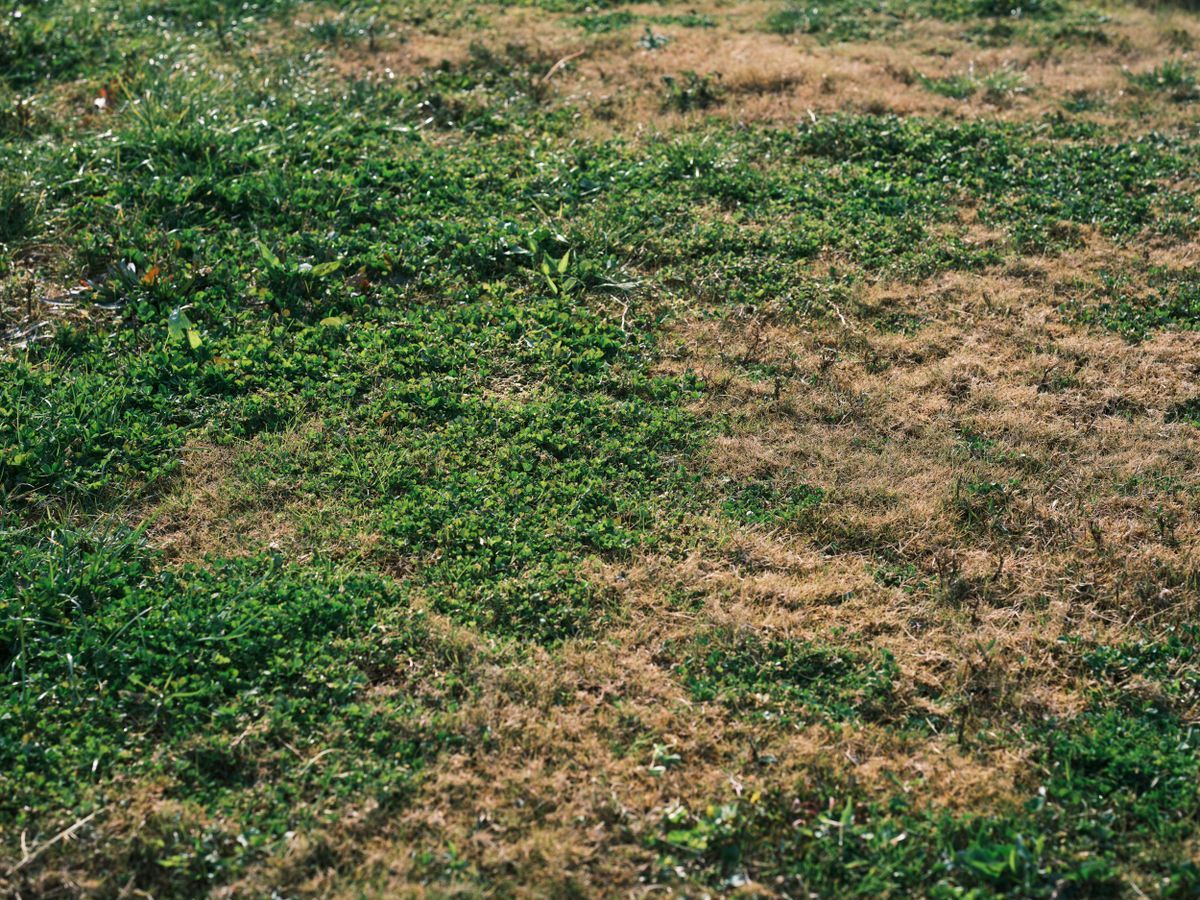
Circular brown or tan patches in the lawn are almost always fungal, and in Central Texas the two most common culprits are brown patch (mainly St. Augustine) and large patch, caused by the fungus Rhizoctonia solani (mainly Zoysia). They behave similarly and respond to similar prevention, but it helps to know which one you’re looking at.
Brown Patch (St. Augustine)
Identification: Roughly circular patches, typically 1–3 feet across, tan to brown, sometimes with a slightly darker ring at the leading edge — often called a “smoke ring.” Tug on a blade right at the patch edge and it tends to pull free easily at the base, with the leaf sheath looking rotted or dark, even though the roots underneath are usually still fine. That last detail is what separates brown patch from take-all root rot, which attacks the roots instead — see Take-All Root Rot if the roots themselves look black and damaged.
When it shows up: Fall and spring, when nights cool into the 50–75°F range and humidity stays high — Central Texas gets this window reliably twice a year, usually late September through November and again in March.
What triggers it: Evening or nighttime watering is the single biggest factor. Wet grass blades overnight are exactly what the fungus needs. Overly lush, over-fertilized grass going into fall is also more susceptible.
Large Patch (Zoysia and Bermuda)
Identification: Larger, often 3–10 feet across, and tends to expand outward in a ring pattern year over year if untreated — new grass in the ring’s center can look fine while the perimeter stays damaged. Also caused by Rhizoctonia, just a variant more suited to Zoysia and Bermuda than brown patch’s St. Augustine preference.
When it shows up: Same seasonal window as brown patch — cool, humid fall and spring conditions.
Treatment (Active Outbreak)
- Stop evening watering immediately — switch to early morning only (5–10am), which is standard practice anyway per our Lawn Care Guide.
- Reduce nitrogen until the outbreak clears — feeding disease-stressed grass heavy nitrogen makes it worse, not better.
- Apply a labeled fungicide — azoxystrobin or myclobutanil are common active ingredients for homeowner use; follow label directions and expect to reapply per the label schedule (often every 14–21 days) until it clears.
- Don’t panic about cosmetic damage — the crown and roots usually survive even when the leaf tissue browns out, so the lawn typically recovers once conditions dry out, especially in spring cases.
Prevention (Do This Every Year)
Apply MicroLife Brown Patch 5-1-3 preventively in September, before the fall disease window opens — 15–20 lbs per 1,000 sq ft. It’s formulated specifically to fight brown patch and large patch with disease-suppressing microbial activity, and it doubles as a complete fertilizer, so you’re not applying an extra product for no reason. This single September application is the highest-leverage thing you can do to avoid a fall outbreak.
Beyond that:
- Keep watering to mornings only, year-round — not just during disease season.
- Don’t overfertilize with nitrogen heading into fall; taper off by late August.
- Improve airflow and reduce shade/moisture buildup where you can (thin overhanging branches, avoid excessive thatch).
Brown Patch vs. Large Patch at a Glance
| Brown Patch | Large Patch | |
|---|---|---|
| Main grass affected | St. Augustine | Zoysia (also Bermuda) |
| Patch size | 1–3 ft | 3–10 ft, ring-shaped |
| Tell-tale sign | Blade pulls loose at base | Ring expands year over year if untreated |
| Season | Fall & spring | Fall & spring |
| Prevention | MicroLife Brown Patch 5-1-3 in September | MicroLife Brown Patch 5-1-3 in September |
Not Sure Which One You Have?
A photo usually settles it — call (936) 510-0964 or reach out through Get a Quote if patches are bad enough that you’re considering replacement sod for the worst spots.