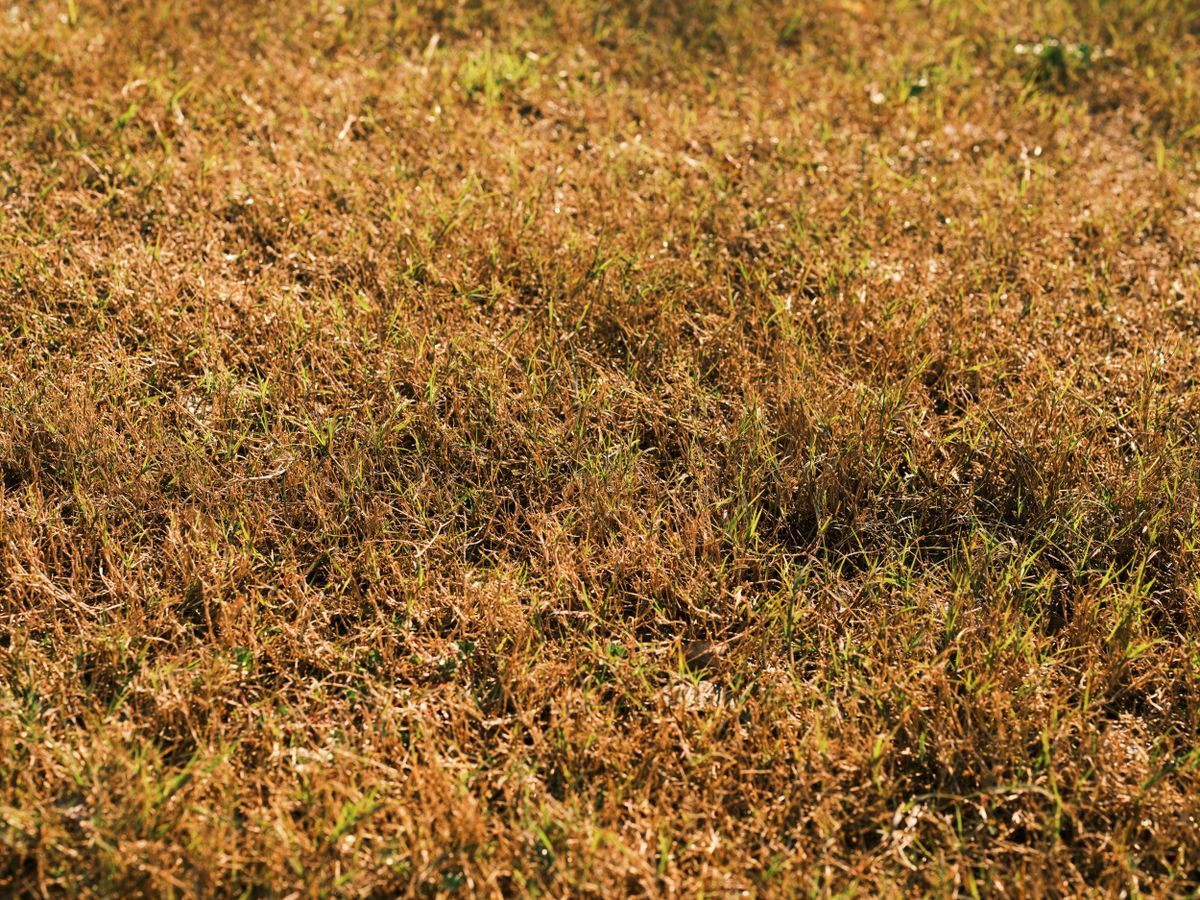
“Why is my grass yellow?” is the single most common question we get from Austin homeowners, and the honest answer is: it depends on the pattern. Yellowing that’s spread evenly across the whole lawn points to a different problem than a yellow patch by the driveway or a yellow ring by the fence. Work through this in order — most people find their answer in the first three.
1. Iron Deficiency From Alkaline Soil (the Austin special)
What it looks like: The whole lawn, or large sections of it, has a pale yellow-green cast rather than deep green — but the grass isn’t dying, thinning, or showing patches. New growth is often the most yellow, since iron doesn’t move well within the plant.
Why it happens here specifically: Central Texas sits on limestone. Limestone means high soil pH — often 7.5–8.5, well above the 6.0–7.0 range most turfgrass prefers. At that pH, iron in the soil locks up chemically and the grass can’t absorb it even when plenty is technically present. This is the most common cause of “generally yellow, not dying” lawns in Austin, Round Rock, Cedar Park, and Georgetown.
The fix: MicroLife Acidifier 6-2-4. It carries 12% sulfur plus humates specifically to lower soil pH and unlock iron uptake — this is the exact problem it’s formulated for. Apply at 15–20 lbs per 1,000 sq ft, and repeat every 3–4 months or whenever the yellow cast returns. Most lawns show a visible color improvement within 1–2 weeks.
2. Overwatering
What it looks like: Yellowing plus a spongy feel underfoot, possibly a sour smell, and grass that looks yellow even though you’ve been watering more, not less.
Why it happens: Waterlogged soil pushes oxygen out of the root zone. Roots that can’t breathe can’t take up nutrients properly, and the grass yellows even though water clearly isn’t the limiting factor.
The fix: Cut back to the schedules in our Lawn Care Guide — generally 1 inch per week for established lawns, run early morning only. Do the finger test before every watering: if the soil is still moist an inch down, skip that cycle.
3. Underfeeding / Nitrogen Deficiency
What it looks like: A uniform light-green-to-yellow lawn, often with slower growth than usual, most noticeable a couple months after your last fertilizer application.
The fix: Get back on schedule. MicroLife Multi-Purpose 6-2-4 works for any grass type; MicroLife Hybrid 20-0-5 is the higher-nitrogen option if Bermuda needs a faster green-up. See our full MicroLife formula guide for which one fits your situation.
4. Disease
Circular brown-yellow patches (not uniform yellowing) usually mean brown patch, large patch, or take-all root rot rather than a nutrient issue. We cover all three in depth in Brown Patch and Large Patch Lawn Disease and Take-All Root Rot — read those if the yellowing is patchy rather than lawn-wide.
5. Dog Urine Spots
What it looks like: Small, sharply-defined dead or yellow circles, often with a ring of extra-dark green grass around the edge (the nitrogen-rich border where the urine diluted before it became concentrated enough to burn).
The fix: Flush the spot with water right after your dog goes, reseed or patch small dead spots, and consider training a single “bathroom zone” in the yard for high-traffic dogs.
6. Dull Mower Blades
What it looks like: A yellow-brown, slightly frayed look to the tips of the grass within a day or two of mowing, across the whole lawn evenly.
Why it happens: Dull blades tear grass tips instead of cutting them cleanly. Torn tissue dries out and turns brown/yellow, and it also opens the door to disease.
The fix: Sharpen or replace mower blades at least once per growing season — twice if you mow a lot of lawns or hit debris often.
Quick Diagnosis Table
| Pattern | Most Likely Cause |
|---|---|
| Whole lawn, pale yellow-green, otherwise healthy | Iron deficiency (alkaline soil) |
| Spongy, smells off, yellow despite heavy watering | Overwatering |
| Uniform light color, slow growth | Underfeeding |
| Circular patches, tan/brown centers | Disease |
| Small sharp circles with dark green ring | Dog urine |
| Frayed yellow tips right after mowing | Dull blades |
Still Not Sure?
Send us a photo or call (936) 510-0964 — we look at yellowing lawns constantly and can usually narrow it down over the phone. If the fix is a product, we’ll tell you exactly what to buy and how much. If it’s something bigger, get a quote for repair sod.