
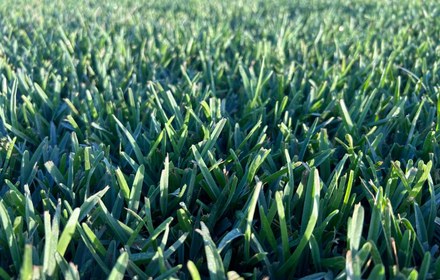
Palmetto St. Augustine is what a lot of Austin homeowners upgrade to once they’ve lived with Raleigh under partial shade and watched it thin out. It’s a finer-bladed, darker-green St. Augustine bred for exactly the mixed sun/shade conditions so common in older, tree-covered Austin neighborhoods like Tarrytown, West Lake Hills, and Rollingwood.
Overview
Palmetto splits the difference between Raleigh’s full-sun toughness and Amerishade’s deep-shade specialization. It holds color and density in as little as 4–5 hours of direct sun per day, which makes it the right call for yards with mature oak canopy or partial building shade — situations where Raleigh would gradually thin and open up to weeds.
Growing Conditions in Central Texas
| Spec | Rating |
|---|---|
| Sunlight | 4–5 hours |
| Drought tolerance | Medium–High |
| Foot traffic | Low–Medium |
| Growth rate | Moderate |
| Maintenance | Medium |
| Coverage per pallet | 450 sq ft |
Palmetto handles the Hill Country’s summer heat and drought stress better than Raleigh does, while also tolerating more shade — a genuinely useful combination for Austin’s mixed-canopy lots. It’s not built for heavy foot traffic, though; if you’ve got kids and a trampoline in the yard, look at a Zoysia or Bermuda variety instead.
Recommended Mowing Height & Frequency
Mow Palmetto at 3–4 inches, every 7–10 days in the growing season — same as Raleigh, since mowing guidance is consistent across St. Augustine varieties. In shaded areas, keep it toward the top of that range (closer to 4 inches); taller grass photosynthesizes more efficiently with less light, which helps it stay dense under tree cover. Never scalp St. Augustine — it has no rhizomes to bounce back from a severe cut.
Watering Needs
Palmetto needs somewhat less water than Raleigh thanks to its better drought tolerance, but plan on 1–1.5 inches per week in summer heat, watered early morning only. Shaded St. Augustine is more prone to gray leaf spot when watered in the evening or when humidity lingers on the blades overnight, so morning watering matters even more in Palmetto’s typical shaded settings.
Fertilizing & MicroLife Recommendations
Feed Palmetto every 6–8 weeks through August with MicroLife Multi-Purpose 6-2-4, a 100% slow-release organic fertilizer safe for kids and pets. If it’s looking pale rather than that deep Palmetto green it’s known for, that’s typically iron deficiency from Austin’s alkaline soils — MicroLife Acidifier 6-2-4 (12% sulfur) lowers soil pH and restores color fast. Stop nitrogen applications after August so the lawn hardens off before winter.
Pros & Cons
Pros:
- Best all-around choice for mixed sun/shade Austin yards
- Finer blade and darker green than Raleigh
- Better drought tolerance than Raleigh
Cons:
- Costs more than Raleigh
- Lower foot-traffic tolerance
- Still needs 4+ hours of sun — not for deep shade
Is Palmetto Right for You?
If your yard gets partial shade from mature trees but isn’t fully shaded, and you want a premium look without going all the way to a specialty shade grass, Palmetto is the right upgrade from Raleigh. For yards with heavier tree cover — under 3-4 hours of direct sun — go with Amerishade instead.
Get Palmetto St. Augustine Delivered in Austin
We deliver fresh-cut Palmetto sod throughout Greater Austin, including Cedar Park, Georgetown, Round Rock, Kyle, Buda, Leander, and Pflugerville. Call (936) 510-0964 or get a free quote for same-day pricing.