
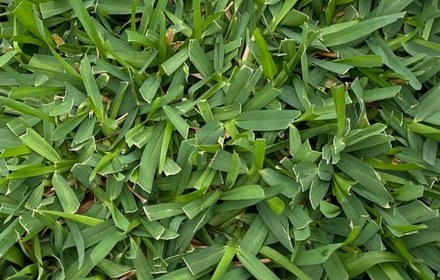
Raleigh St. Augustine is the grass you’ll see on more Austin-area lawns than any other variety. It’s affordable, it establishes fast, and it holds up well in full sun across our Central Texas clay soils — which is exactly why it’s become the default choice for large resods and new residential lawns from Round Rock to Buda.
Overview
Raleigh is a workhorse St. Augustine. It doesn’t have the fine blade or premium color of Palmetto, and it can’t handle shade the way Amerishade can — but it’s the best value on the list, and it does the fundamentals well: full-sun coverage, fast establishment, and a thick, uniform carpet that outcompetes most weeds once it’s rooted.
It’s the grass we recommend most often for budget-conscious buyers, large-lot resods, and anyone who wants a green, low-drama lawn without paying a premium.
Growing Conditions in Central Texas
| Spec | Rating |
|---|---|
| Sunlight | 6–7 hours (full sun) |
| Drought tolerance | Medium |
| Foot traffic | Medium |
| Growth rate | Fast |
| Maintenance | Medium |
| Coverage per pallet | 450 sq ft |
Raleigh wants sun. It’ll survive light shade but thins out fast under trees — if more than a third of your yard sits in shade most of the day, look at Palmetto or Amerishade instead. It adapts well to the Blackland clay and limestone-heavy soils common across the Austin area, but like every St. Augustine, it’s not a great fit for high-traffic areas like dog runs or play zones — Bermuda or Zoysia will hold up better there.
Recommended Mowing Height & Frequency
Mow Raleigh at 3–4 inches, every 7–10 days during the growing season (spring through early fall). Never cut more than a third of the blade length in a single mow — scalping stresses St. Augustine badly, and unlike Bermuda, it has no underground rhizomes to recover from severe cuts. If you let it get too tall between mows, raise the deck and bring the height down gradually over two or three cuts instead of scalping it back down in one pass.
Watering Needs
Raleigh needs about 1–1.5 inches of water per week during Austin’s hot summer months, less in spring and fall. Water early morning (5–10am) — evening watering in our humidity is the #1 cause of gray leaf spot and brown patch in St. Augustine lawns. New sod needs twice-daily watering — once in the morning, once in the evening, never during midday heat — for 2–3 weeks, then transitioning to the established schedule once it’s rooted (tug-test a corner — resistance means it’s taking hold).
Fertilizing & MicroLife Recommendations
Raleigh needs roughly 2–3 lbs of nitrogen per 1,000 sq ft per year, applied every 6–8 weeks through August, then nothing until spring. We recommend MicroLife Multi-Purpose 6-2-4 as the all-around choice for Raleigh — it’s 100% slow-release, safe for kids and pets right after application, and won’t burn the lawn. If your Raleigh is looking pale or yellow rather than deep green, that’s usually an iron deficiency from our alkaline soil — MicroLife Acidifier 6-2-4 lowers soil pH and fixes yellowing fast. Never fertilize new sod for the first 30 days, and apply at half-rate the first time.
Pros & Cons
Pros:
- Most affordable St. Augustine we carry
- Fast establishment, thick coverage
- Handles Central Texas clay well
- Reliable, predictable performance
Cons:
- Susceptible to brown patch, gray leaf spot, and chinch bugs
- Not shade-tolerant — thins out under trees
- Medium foot traffic tolerance only
Is Raleigh Right for You?
If you’ve got a mostly sunny yard, want a proven and affordable grass, and aren’t dealing with heavy shade or constant foot traffic, Raleigh is the easy call. If your yard has significant tree cover, step up to Palmetto or Amerishade instead — Raleigh will just thin out and disappoint you in those spots.
Get Raleigh St. Augustine Delivered in Austin
We deliver fresh-cut Raleigh sod across Greater Austin — Round Rock, Cedar Park, Pflugerville, Georgetown, Kyle, Buda, and Leander included. Call (936) 510-0964 or get a free quote and we’ll tell you exactly how many pallets your yard needs.